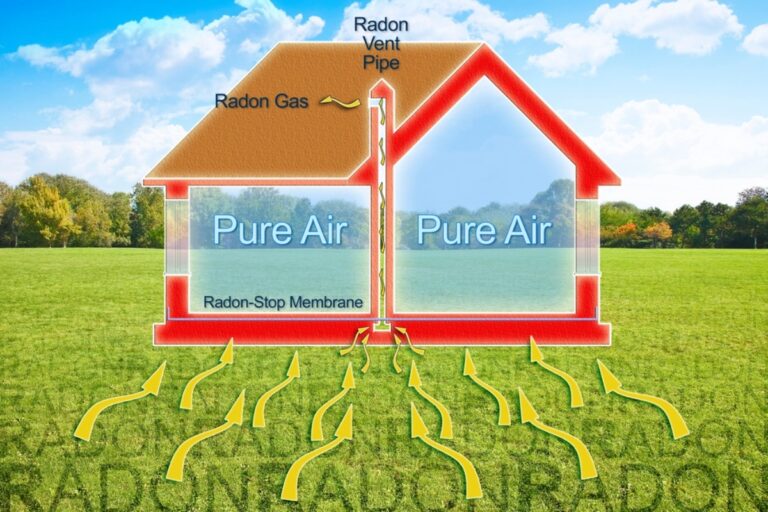
Many homeowners and homebuyers understandably wonder, what causes radon in homes, and do all homes have radon? The answer is complex, but fundamentally, radon is a naturally occurring radioactive gas that forms from the breakdown of uranium in soil and rock. While all homes have some level of radon, concentrations vary significantly based on a combination of geological factors, soil characteristics, and how a house is built and ventilated. High radon levels are primarily caused by the unique interplay between the soil beneath a home and the structural pathways that allow this gas to enter and accumulate inside, posing a silent risk to the health of the people living there.
The Natural Origin: Radon’s Journey from Earth to Your Home
To truly understand why radon might be an issue in your home, we first need to look underground. Radon’s story begins with radium, a radioactive metal found in minute quantities in nearly all soils and rocks across the globe. As radium decays, it produces radon gas. This gas is odorless, colorless, and tasteless, making it impossible to detect without specialized testing.
The earth beneath us is constantly generating radon. Once formed, this gas can move freely through porous soils, gravel, and cracked rock formations. It’s not just a concern in areas known for uranium deposits; even seemingly benign soil can be a source. The key factor isn’t necessarily massive uranium deposits, but rather the consistent, albeit slow, decay of radium present in the ground.
Geological Influences on Radon Potential
Certain geological conditions can increase the likelihood of higher radon concentrations in the surrounding soil. Areas with granite, shale, phosphate, and volcanic rock often have elevated levels of naturally occurring uranium. However, even in regions without these specific rock types, the soil structure itself plays a crucial role. Loose, permeable soils—like sandy or gravelly soils—allow radon to migrate more easily than dense, clay-rich soils. This means that a home built on highly permeable soil, even if the underlying rock has average uranium content, could still be more susceptible to radon entry.
How Radon Enters Your Living Space: Pathways and Pressure Differences
Radon doesn’t just seep into your home; it’s often drawn in. The primary mechanism for radon entry is a difference in air pressure between the inside of your home and the soil beneath it. Homes typically have a slightly lower air pressure inside than the surrounding soil, a phenomenon known as the “stack effect” or “house depressurization.” This pressure difference acts like a vacuum, pulling soil gases, including radon, into the building through any available opening.
Common Entry Points and Structural Vulnerabilities
Radon can enter a home through a surprising number of pathways, many of which are invisible to the naked eye. These include:
- Cracks in concrete slabs: Even hairline cracks can be significant entry points.
- Expansion joints: Where concrete slabs meet foundation walls.
- Floor-wall joints: The seam where the basement floor meets the foundation wall.
- Openings around utility penetrations: Gaps around pipes, wires, and sumps.
- Pores in concrete blocks or poured concrete: Concrete, while dense, is still porous at a microscopic level.
- Loose-fitting pipe penetrations: Gaps around water pipes, sewer lines, and electrical conduits.
- Sump pits and floor drains: Especially if not properly sealed or trapped.
- Earthen floors: In crawl spaces or basements, direct contact with soil allows for easy entry.
It’s important to remember that even a well-constructed home can have these pathways. Over time, foundations can settle, concrete can crack, and seals can degrade, creating new opportunities for radon to enter.
Building Variables and Ventilation: The Indoor Accumulation Factor
Once radon enters a home, its concentration depends on how effectively it’s dispersed or trapped. This is where building design, ventilation patterns, and even occupant behavior come into play.
The Role of Air Exchange and Ventilation
Homes that are tightly sealed for energy efficiency, while excellent for reducing heating and cooling costs, can inadvertently trap indoor air pollutants, including radon. Modern construction techniques often prioritize airtightness, which can reduce the natural air exchange with the outdoors. Without adequate ventilation, radon gas that enters the home can accumulate to elevated levels rather than being diluted and dispersed.
Conversely, homes with high natural ventilation—perhaps older homes with draftier windows or more air leakage—might allow radon to escape more readily, even if the entry rate is similar to a tighter home. However, relying on drafts for radon mitigation is not a reliable long-term solution and comes with its own energy efficiency drawbacks.
Foundation Type and Its Influence
The type of foundation a home has also influences radon entry potential:
- Basements: Basements are often the most susceptible because they are largely surrounded by soil, providing extensive contact areas for radon entry.
- Crawl Spaces: Both unvented and vented crawl spaces can be sources. Unvented crawl spaces allow radon to accumulate and then enter the living space above. Even vented crawl spaces can draw radon in, especially if the vents are closed or insufficient, or if the living space above is depressurized relative to the crawl space.
- Slab-on-Grade: While seemingly less exposed to soil, slab-on-grade foundations can still have significant radon entry through cracks, utility penetrations, and floor-wall joints. The pressure difference still exists, drawing gas upwards.
Understanding these variables helps us appreciate why even two identical homes built next to each other might have different radon levels. The slight differences in soil permeability, foundation cracks, or even the way a particular home is used (e.g., how often windows are opened) can all contribute to the final indoor concentration.
The Human Health Imperative: Why Understanding Radon Matters
Ultimately, the reason we delve into these technical details about what causes radon in homes is because of its impact on human health. Radon is a known carcinogen and the leading cause of lung cancer among non-smokers. Protecting the people living and working in buildings is the driving force behind understanding and addressing this invisible threat.
While do all homes have radon is a question with a “yes” answer, the crucial distinction lies in the concentration. It’s not about eradicating all radon, which is impossible due to its natural origin, but about reducing indoor levels to a safe, acceptable range. This is why testing your home for radon is so vital, regardless of where you live or how your home is built. If elevated levels are found, industry experts can design bespoke, site-specific solutions that effectively interrupt radon’s journey from the earth to your living space, ensuring a clean, safe environment for your occupants.