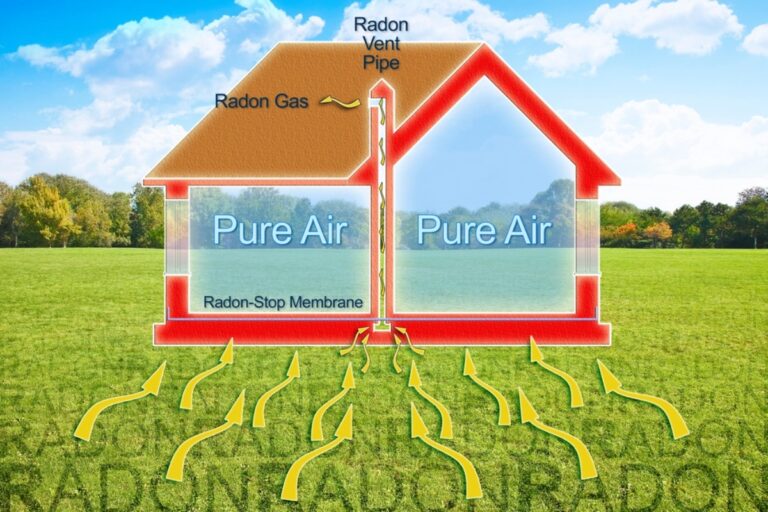
Radon is a naturally occurring, invisible, and odorless radioactive gas that originates from the breakdown of uranium in soil, rock, and water. It’s found in nearly all soils, and as it decays, it rises through the ground and can enter any building through cracks and other openings in the foundation. Understanding where radon comes from is the first step in protecting the health of the people living and working in buildings, as exposure to elevated levels of radon can pose significant health risks.
The Earth’s Radioactive Core: Uranium’s Decay Chain
To truly grasp where radon comes from, we need to look deep into the Earth’s crust. Uranium, a heavy, radioactive metal, is a natural component of many types of rock and soil. While uranium itself isn’t directly the problem, it’s the starting point of a long radioactive decay chain that ultimately produces radon.
This decay chain is a series of transformations where one radioactive element changes into another, releasing energy in the process. Think of it like a cascade:
- Uranium-238 (U-238) slowly decays into…
- Thorium-234 (Th-234), which then decays into…
- Protactinium-234 (Pa-234), and so on, through many intermediate steps.
Eventually, this chain leads to Radium-226 (Ra-226). Radium-226 is the immediate parent of radon. When radium-226 decays, it emits an alpha particle and transforms into Radon-222 (Rn-222). This is the specific isotope of radon that is most commonly found in indoor air and is the primary concern for human health.
The Role of Soil and Rock Composition
The concentration of uranium and radium in the ground dictates the potential for radon generation. Areas with higher concentrations of these elements in their underlying geology will naturally produce more radon gas. This is why radon levels can vary significantly from one location to another, even within the same town or neighborhood. Geological factors like granite, shale, phosphates, and volcanic rocks are often associated with higher uranium content, and consequently, higher radon potential.
How Radon Travels from the Ground to Your Building
Once radon gas is formed in the soil, it doesn’t just stay put. It’s a gas, meaning it’s mobile and can move through porous materials. This is the critical link in understanding where radon comes from and how it becomes a concern for indoor air quality.
The Journey Through Soil Pores
Radon gas migrates through the tiny air pockets and cracks within the soil. It’s constantly being produced, creating a slight pressure differential that drives it upward. The ease with which it moves depends on soil permeability – sandy or gravelly soils allow radon to travel more freely than dense clay soils. Water in the soil can also play a role; saturated soils can trap radon, but as they dry out, the trapped gas can be released in a concentrated burst.
The “Stack Effect” and Indoor Entry Points
The primary mechanism for radon entering a building is often called the “stack effect.” This occurs because the air pressure inside a building is typically lower than the air pressure in the soil directly beneath it, especially during colder months when warm indoor air rises and escapes through upper levels, drawing in cooler air from below. This pressure difference acts like a vacuum, literally drawing radon gas from the soil into the building.
Radon can enter a building through various openings in the foundation, including:
- Cracks in solid foundations (slabs, walls)
- Construction joints
- Gaps around utility penetrations (pipes, wires)
- Floor drains
- Sump pumps
- Hollow-block walls
- Pores in concrete block and highly permeable materials
Even buildings without basements or with crawl spaces are susceptible, as the gas can still seep through foundations and into the living space above.
Why Understanding Radon’s Origin Matters for Your Health
Knowing where radon comes from is not just an academic exercise; it’s fundamental to protecting the people in your building. Radon progeny—the short-lived radioactive decay products of radon—are what pose the most significant health risk. When inhaled, these tiny radioactive particles can lodge in the lungs and emit radiation, damaging lung tissue and increasing the risk of lung cancer. The U.S. Environmental Protection Agency (EPA) estimates that radon is responsible for about 21,000 lung cancer deaths each year.
Because radon is invisible, odorless, and tasteless, the only way to know if your building has elevated levels is through testing. If testing reveals high levels, effective mitigation strategies can be implemented to redirect the gas away from the building, ensuring a clean, safe environment for occupants. Industry experts, deeply committed to human health, specialize in understanding these complex interactions between geology, building science, and air quality to provide tailored solutions. These solutions are always designed with your occupants’ well-being as the highest priority, ensuring that the air they breathe inside is as clean and safe as it should be.